
About Meredith Wikstrom
Meredith is a Senior Consultant on the UDig Design team.
This site uses cookies to enhance your browsing experience and deliver personalized content. By continuing to use this site, you consent to our use of cookies.
COOKIE POLICY
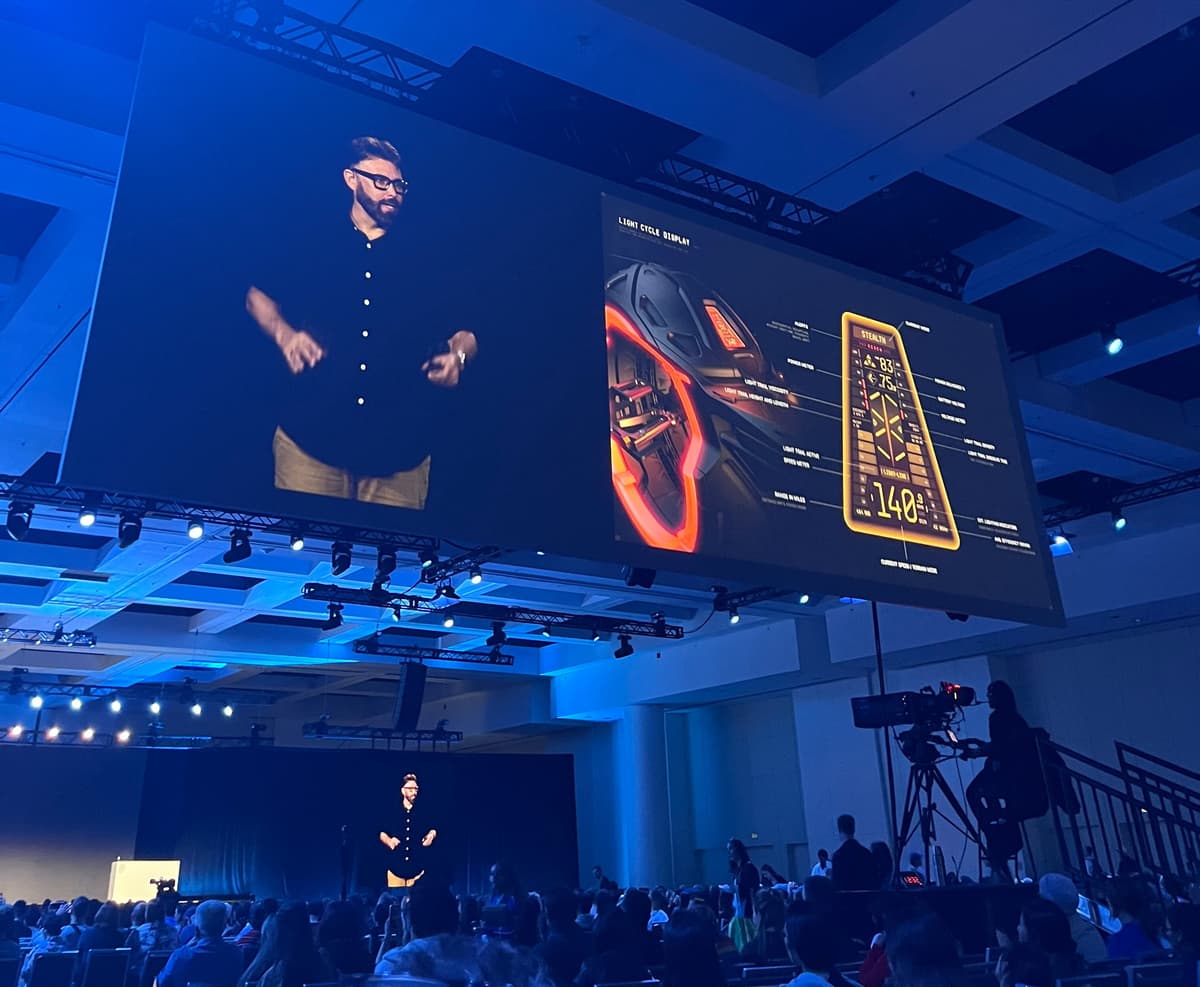
 Ryan Powell said something at Config that I’ve been trying to articulate for years. Building trust isn’t about transparency, it’s about communication design. He runs design at Waymo. His version of the problem is a stranger getting into a car that drives itself. No relationship. No shared history. Just a person, a seat, and a system making decisions they can’t see. His answer isn’t to expose every decision. It’s to communicate intent clearly enough that the person can breathe. He calls that legibility.
Earlier that same day, Jayse Hansen walked us through something that sounds completely different but isn’t. He designs fictional interfaces like the HUDs in Tron: Ares, the cockpit interface in Top Gun: Maverick, displays that audiences accept as real without consciously understanding why. None of them have to work. They have to feel like they should. His design challenge: communicate intent to someone with no context, in seconds, with no explanation available. The interface carries the meaning without him in the room.
Same problem. Different medium.
I sit down with strangers for a living. Stakeholders, employees, subject matter experts — people who’ve been told a design strategist is coming and spent the morning deciding what that means. I’ve logged sessions in the dozens, people in the hundreds, across rescheduled flights and back-to-back conversations that blur together by the end of the week.
What I’ve learned is that before the first question, the most important design work is already happening.
Someone settles into their chair and, unprompted, apologizes. They were worried this was about metrics. They thought it might be connected to layoffs. They rehearsed. What they couldn’t see, because I hadn’t made it visible yet, was my intent. And when intent is invisible, people spend their energy managing uncertainty instead of thinking alongside you.
That’s not a relationship problem. It’s a legibility problem. And it costs you the depth of the conversation.
Powell draws a line between automation and legibility. Automation is the system doing the work. Legibility is the system communicating what it intends to do next. When those two things come apart, when something is competent but unreadable, trust erodes even when nothing goes wrong. The car stops smoothly. You still brace.
I’ve felt that dynamic in discovery sessions more times than I’d care to admit. A well-run process can still feel opaque to the person on the other side of it. They’re answering questions. They don’t know what you’re building toward. That’s not a failure of transparency because I can’t always share the full strategic picture mid-process. But it is a legibility failure, and the conversation stays shallow because of it.
Jayse solves this in the most constrained version of the problem imaginable. Seconds of screen time. No user manual. The interface has to make its own logic felt instantly to someone seeing it for the first time in a way that lands as inevitable rather than explained. The intent has to travel without him.
That’s the challenge every designer faces, whether you’re working in film, on a product, or in a room with someone who was quietly terrified on the way over.
My colleague, Kelly May, wrote about language as design and the idea that what you bring to a tool in terms of clarity and intent is now the primary skill gap for design teams. She’s right. And the same principle applies in the room before the tool is ever opened. The words you use to frame a discovery session, introduce a process, or respond to someone’s unspoken fear are design decisions. They shape what gets made.
Kristen Castells, our Design Practice Lead, has made the case that design strategy is a business decision and that the scarce skill in an AI-accelerated world is knowing what’s worth building. That argument holds. And what makes it possible to answer that question well is whether the people in the room trust what you’re trying to do. Legibility is the condition. Strategy is what follows.
Design strategy isn’t a deliverable. It’s not a research report or a journey map although it produces both. At its core, it’s the practice of making intent legible. To clients. To teams. To the people who will eventually touch the work long after you’ve left the room.
The methodology matters. The tools matter. But none of it lands without trust. Trust isn’t extended because you’re competent. It’s extended because people can read you.
I’ve learned to start the work earlier — in how an engagement is framed before it begins, in the first conversation, in how I walk into a room. By the time someone sits down across from me, they should already know what this is for. When they don’t, that’s a design problem I own.
The most important design decisions I make often happen before the first slide. That moment when someone confesses they were afraid of what this meeting was for, that’s not a failure to note and move past. It’s a signal. It tells me exactly what I failed to communicate, and exactly what I need to build next time.
Legibility isn’t a feature or a phase. It’s the work. And it starts long before anyone enters the room.
Meredith is a Senior Consultant on the UDig Design team.